General
The first production version of the Sherman has a box-shaped hull of rolled armour plate, first riveted and later welded. The upper hull is made of cast armour steel and carries a turret, also of cast armour steel. The armour varies in thickness from 1.3 cm to 8.9 cm; the front of the hull is 5 cm thick. The tank is powered by an adapted aircraft engine. The Continental R975 C1 or R975 C4 is a nine-cylinder, four-stroke, overhead-valve petrol engine in a radial layout with forced air cooling. Its displacement is almost sixteen litres, and it delivers a maximum of 460 hp at 2,400 rpm. The engine sits at the rear and drives the five-speed gearbox at the front through a dry-plate clutch and a propeller shaft. Because of the height of the radial engine, the propeller shaft takes up a lot of space in the middle of the tank. As the turret is mounted above the propeller shaft, the Sherman has a fairly tall hull. The tracks are 42 cm wide, each made up of 79 links. These consist of a steel frame with a covering of rubber, steel or a combination of both. Each frame holds two pins vulcanised into rubber bushings. The pins are joined by connectors with integrated guide horns. On each side the Sherman has six rubber-tyred road wheels. These wheels are suspended on arms and mounted in pairs on a bogie. The suspension uses vertical volute springs. The drive sprocket is at the front and the idler wheel at the rear.
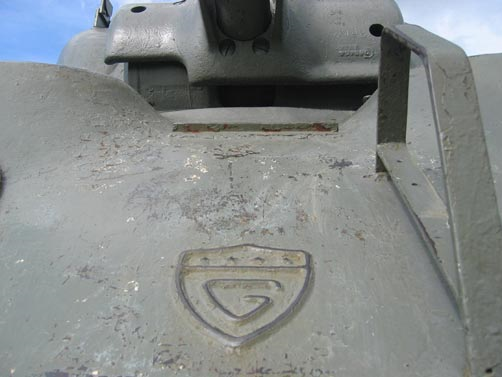
The original design of the Sherman tank as described above is called ‘Medium Tank M4A1’, and this was the first type of Sherman to go into production. It was built by three plants: Lima Locomotive Works (Lima, Ohio), Pressed Steel Car Company (Pittsburgh, Pennsylvania) and Pacific Car & Foundry Company (Renton, Washington). Between February 1942 and December 1943 these plants built a total of 6,281 M4A1s with a 75 mm gun. In January 1944 a completely modernised generation of Sherman tanks went into production. Besides versions with the 75 mm gun, there were now also versions with a 76 mm gun (in a new turret) and with a 105 mm howitzer. Countless large and small improvements were made as well (source: H.L. Spoelstra).
In active service
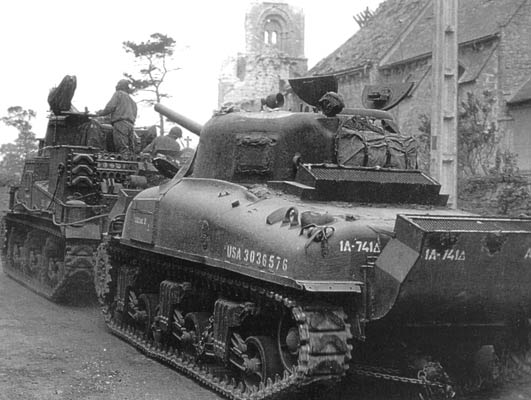
The Sherman M4A1 was first deployed outside America in North Africa, where the US armored divisions stationed there were to train with this new tank, the successor to the awkward M3. When Erwin Rommel and his Afrika Korps took Tobruk and threatened the Suez Canal, the Americans wanted to gather all available Sherman tanks and use them to equip the 2nd US Armored Division under Patton. Delivering the tanks to the British proved quicker, however, and so the tank gained its first combat experience in British service: 300 tanks were deployed by the British Eighth Army at the Second Battle of El Alamein in October 1942. Its first combat in American service followed a month later during Operation Torch, the invasion of French North Africa. The Sherman was used successfully against the PzKpfw III with the long 50 mm L60 gun and the PzKpfw IV with the short 75 mm L24 gun. The German Tiger tank was in a different league and could only be knocked out by making use of the Sherman’s better manoeuvrability and by deploying Shermans in large numbers. This came at the cost of heavy losses in tanks and crews. The M4 and M4A1 formed the backbone of the Armored Divisions until the end of 1944, when the M4A3 became available. By the time of the Normandy landings the tank was no longer a match for the PzKpfw IV with the long 75 mm L48 gun. Nor did it stand a chance against German anti-tank guns such as the 75 mm Pak 40 or the dreaded ‘88’. To give the crews some chance of surviving this unequal fight, the tanks were fitted with extra armour (appliqué armor). The Sherman earned nicknames such as “Tommycooker” and “Ronson”, after the cigarette-lighter maker whose slogan was “Lights up the first time, every time!”. Polish crews were just as blunt with their nickname: “The Burning Grave” (source: Wikipedia).
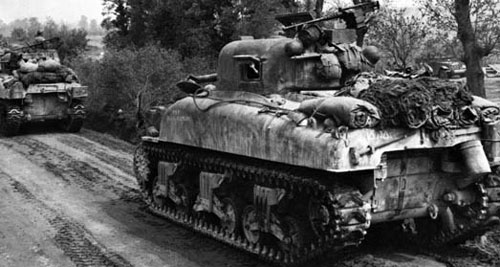
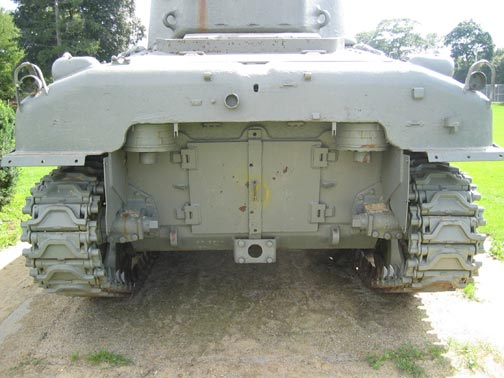
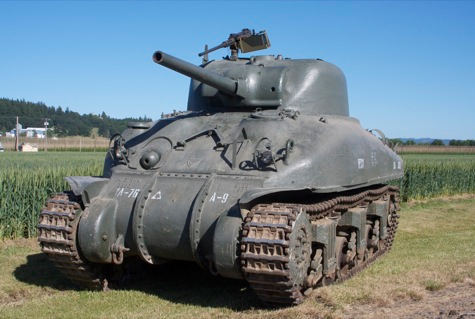
Sherman M4A1 Intermediate with appliqué armor
Countless changes and improvements were made to the Sherman. In general, each type can be divided into three hull variants: the early, intermediate and late versions. The main features of the early version are the direct vision slots in the hoods at the front of the hull and the use of components from the M3 tank. The intermediate version can be recognised by the periscope openings in front of the hatches on top of the hoods. The late version has the front of the hull at a different angle (57 degrees) and larger, angled hatches. The direct vision slots were a weak point in the Sherman’s armour, and armour plates were soon welded over them in the field. In the new hull design they were dropped, which made the hoods slightly larger and left room for a periscope in front of the hatches. The rear of the hull kept the same recess that can also be seen on the early version and on the M4.
The transmission housing of the M4A1 consists of three sections bolted together. Here too there are different versions, distinguished by the position of the towing eye brackets, cable clamps and cast-in numbers. On each side, the running gear of the Sherman consists of a drive sprocket, three bogies each with two road wheels and a return roller, and an idler wheel. The manufacturers also produced different versions of these parts. It is therefore almost impossible to put together a standard set of the correct running gear for an M4A1 Intermediate. All parts are also interchangeable, so field repairs used whatever happened to be in stock at the time.
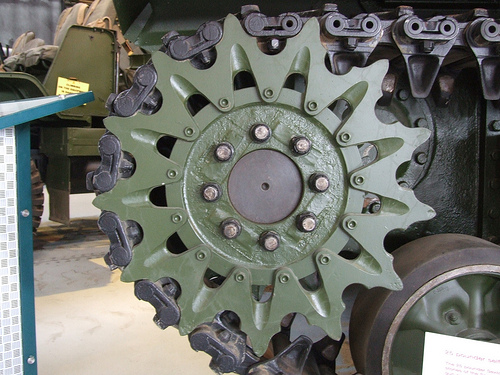
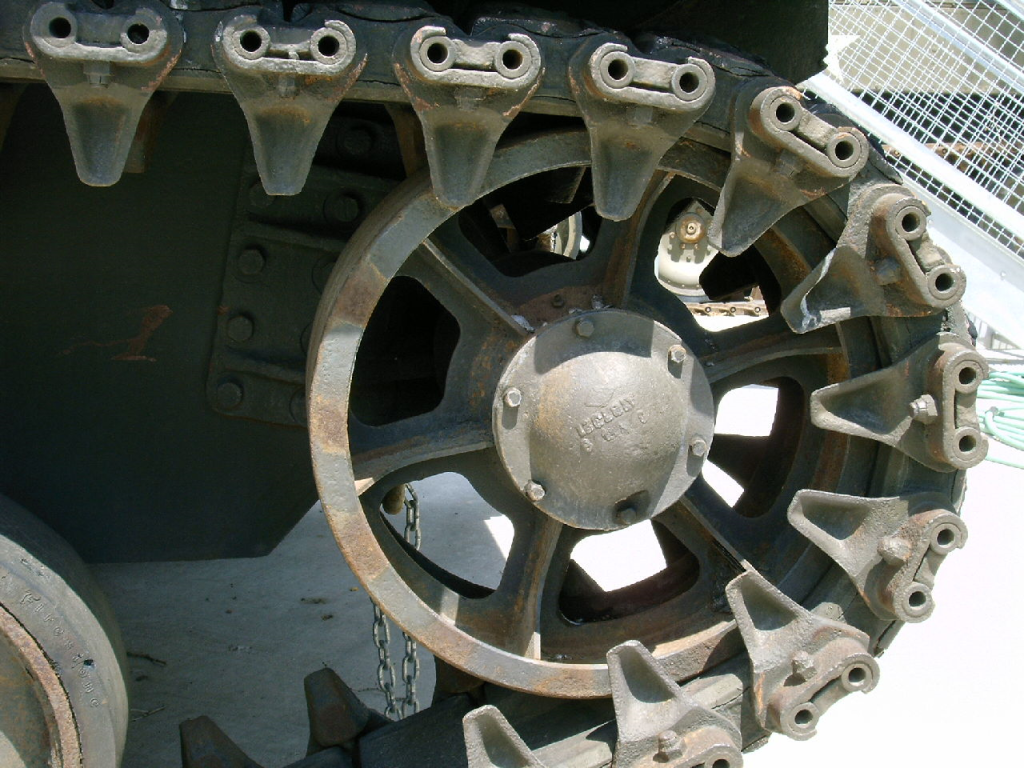
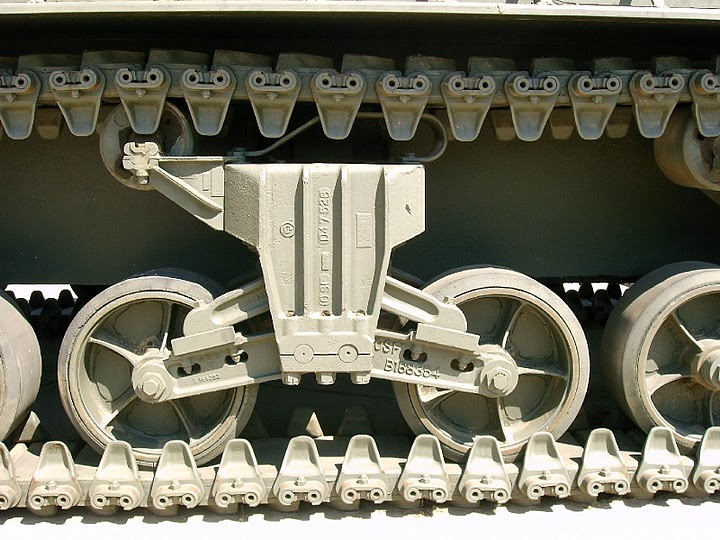
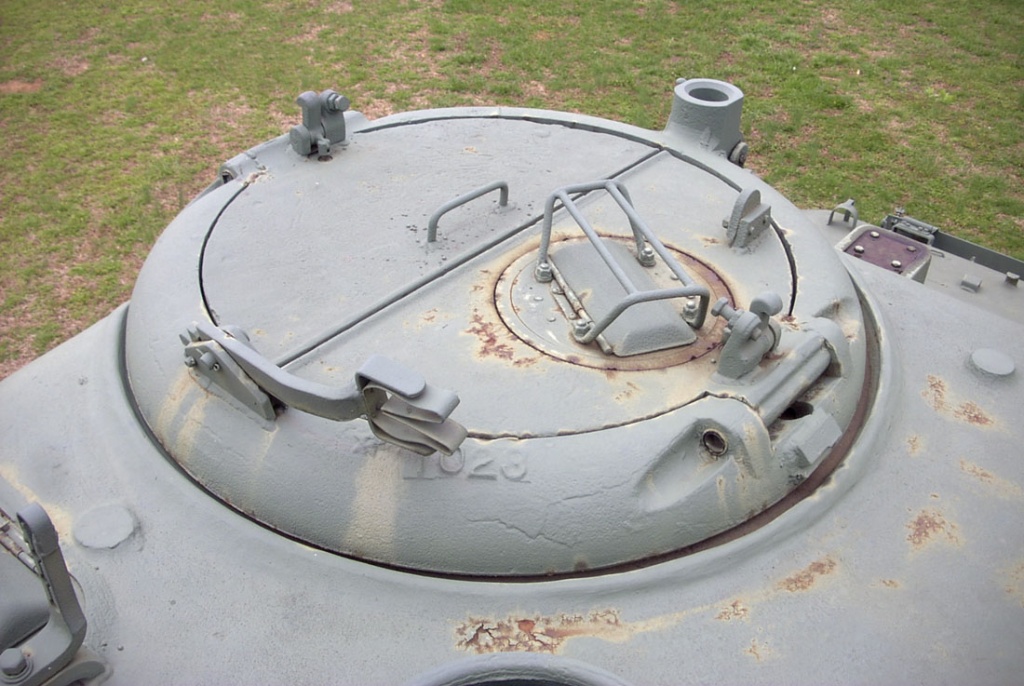
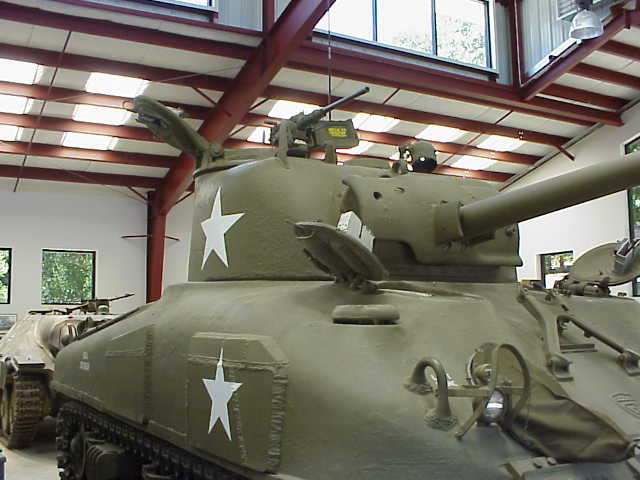
The turret of the Sherman in this version is an early turret (low bustle) with the commander’s hatch on top. This hatch is made of two parts that fold open. On the left side is an ejection port for empty shell casings. Where the turret meets the gun sits an M34A1 gun mount.
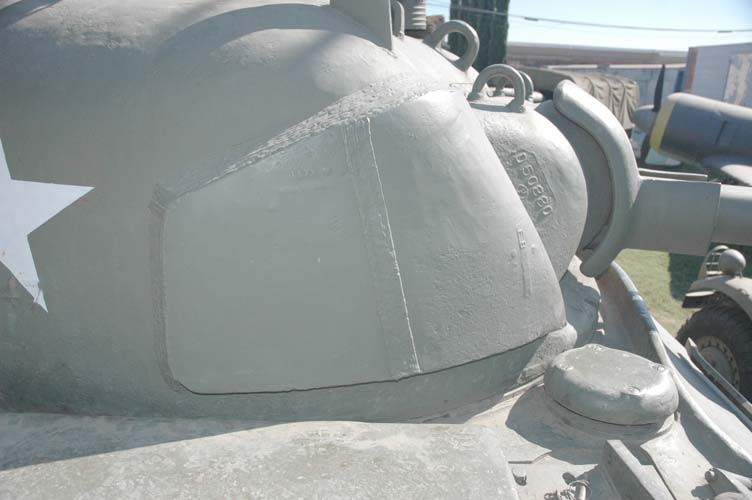
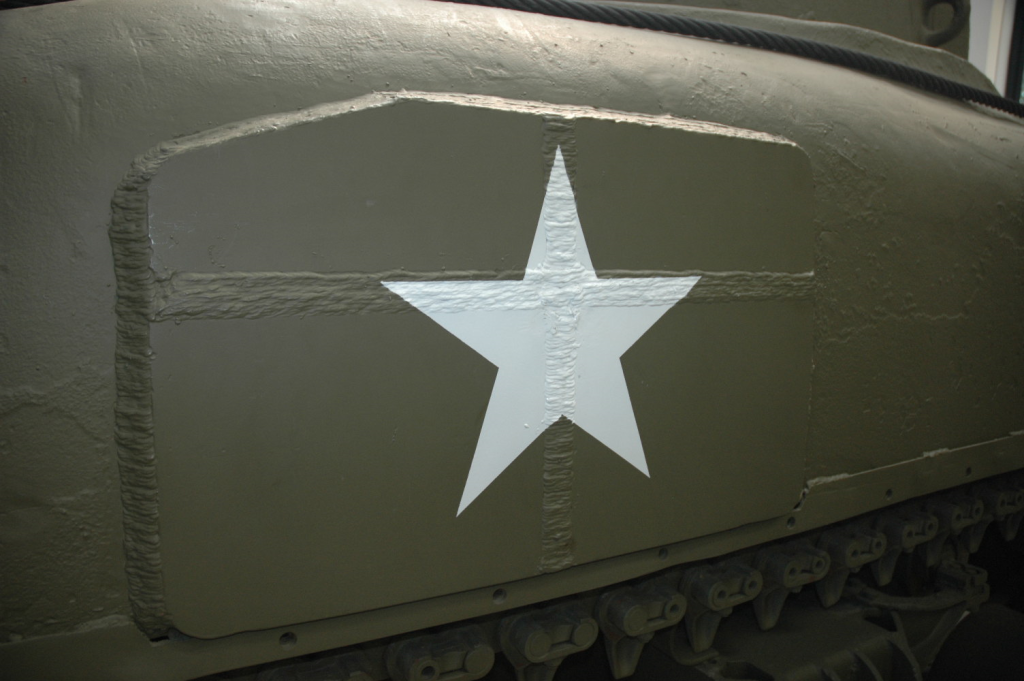
To give the Sherman some protection against anti-tank weapons such as the Panzerschreck and the Panzerfaust, these tanks were fitted with extra armour (appliqué armor) in England before being deployed in Normandy. This extra armour was placed where the ammunition was stored inside the tank. The solution worked reasonably well. In the field, crews gave their Shermans additional ‘armour’ in the form of sandbags, sections of track, wood and even concrete! All of this added weight and therefore increased the wear on the drivetrain and running gear. On the late versions the appliqué armor was replaced by storing the shells inside the tank in a non-flammable liquid.
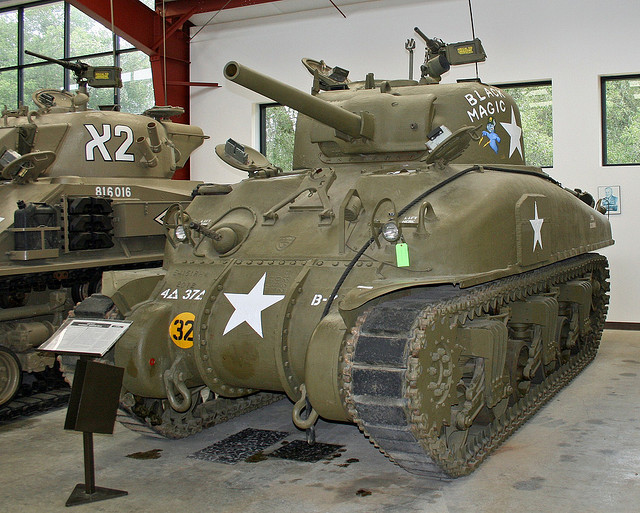
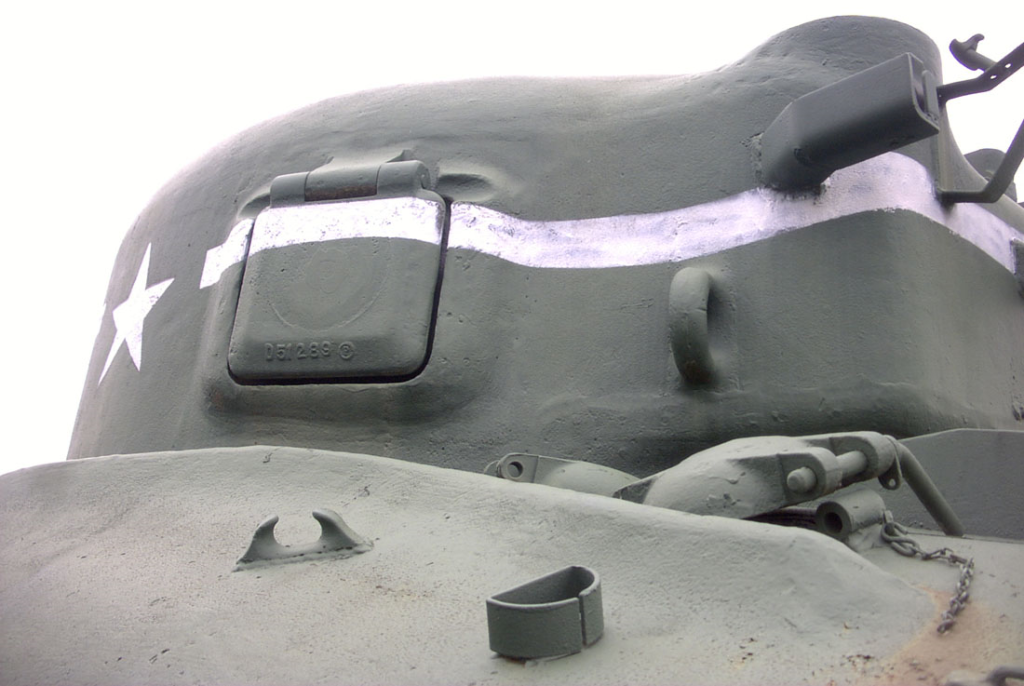
This modification led to the addition of the letter W (for Wet) to the name.
This tank
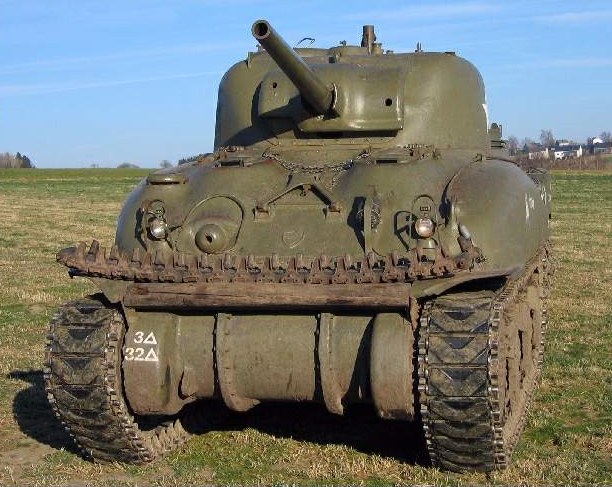
The example now on display is described in official documents as an M4A1E9. As a result of numerous modifications the Sherman kept getting heavier. To reduce ground pressure, a new type of running gear with matching tracks was developed. In the process, widening the existing running gear by fitting spacers was also tried. This places the track 11.4 cm away from the hull on both sides. The method gave good results, and so the E9 version was born. Whether this version actually took part in combat with the Americans is not known to me.
This Sherman was supplied by the Americans to the Netherlands under the Marshall Plan, and more specifically the Mutual Defense Assistance Program (MDAP), so that the Netherlands could fulfil its NATO obligations. In 1951 the Dutch army had 50 tanks of this type in service.
They were used in the tank and reconnaissance units of the cavalry. From 1953 the tank units began replacing the Sherman with the British Centurion tank. In 1957 the M4A1E9 was withdrawn from service altogether. One example then went to the collection of the Army Museum (Legermuseum), and the rest were used, among other things, as targets on training areas (sources: CIC Legermuseum and H.L. Spoelstra).
Detail photos of the spacers on an M4A1E9 can be seen at the grounds of the Bernhard barracks in Amersfoort.
More information about the M4 Sherman can be found at: en.wikipedia.org/wiki/M4_Sherman